

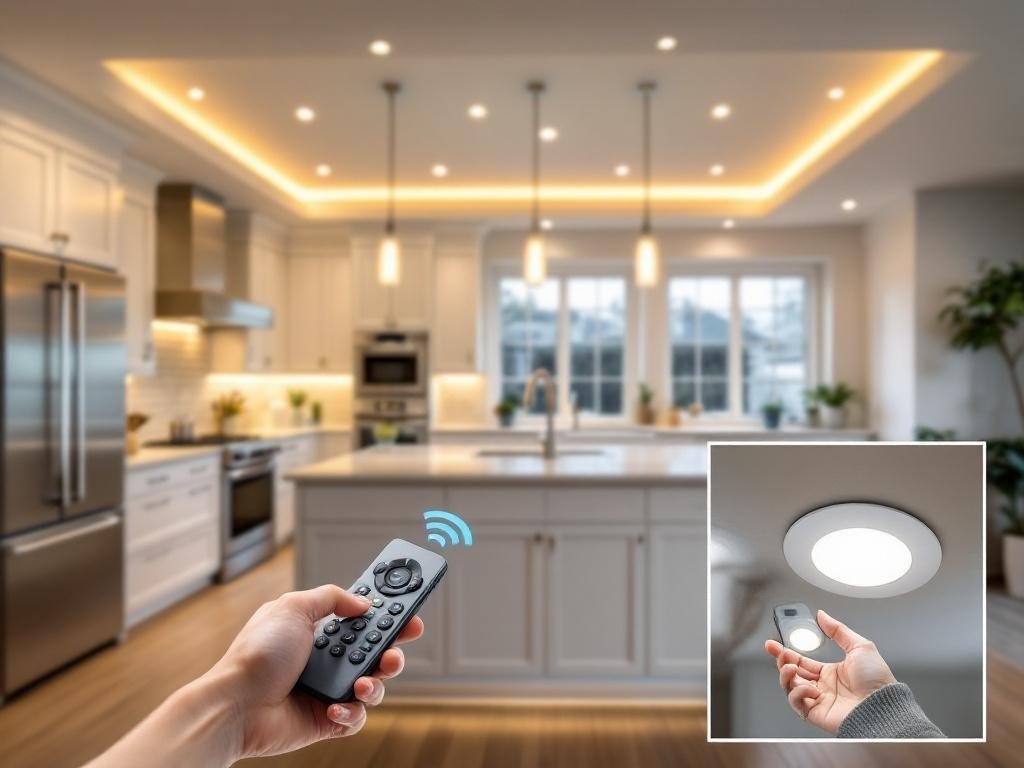
LED puck lights are compact, versatile fixtures used for accent, task, and general lighting. This article explores puck lights, battery-powered and remote-controlled options, ceiling and recessed installations, and LED can lights. It combines technical details, installation guidance, and practical buying tips to help homeowners and professionals choose and install efficient, attractive lighting for kitchens, closets, and ceilings.
What LED puck lights are and how they work
Puck lights are compact, disc-shaped lighting fixtures—typically 2-3 inches in diameter—that deliver focused illumination in small or hard-to-reach spaces. According to Wikipedia and leading interior design sources, their most common uses include under-cabinet kitchen lighting, accenting shelves or displays, brightening closets, and highlighting artwork in display cases. The “puck” name comes from the hockey-puck-like shape, lending itself to low-profile, easily concealed installations where precise light beams are ideal.
LED (light-emitting diode) puck lights operate using semiconductor technology: an electric current passes through a microchip, energizing atoms in a layer of material. As electrons drop to a lower energy level, photons (light) are released, creating visible light. Wikipedia defines LEDs as highly efficient semiconductor devices, making them perfect for puck fixtures. LED puck lights excel because they use a fraction of the power of older technologies, generate significantly less heat (important for confined spaces), and typically have service lives exceeding 25,000 hours.
LED puck lights are constructed in several ways:
- LED modules: Replaceable circuit boards with multiple diodes; more repairable, but less common in compact fixtures.
- SMD (surface-mount device) chips: Small chips mounted onto the printed circuit board, offering uniform light and high efficiency.
- Integrated LED assemblies: The diodes are built directly into the fixture; this is most common for modern puck lights, maximizing slimness and design flexibility but rendering the light non-repairable if the LED fails.
These differences impact everything from beam quality to serviceability.
Compared to incandescent or fluorescent puck lights, LEDs offer about 70-100 lumens per watt (versus 10-15 for incandescent and 35-70 for fluorescent, per manufacturer specs and EnergyStar.gov). LEDs emit minimal heat, reducing fire risk, and far outlast alternatives (often over 10x the lifespan).
Technical Glossary:
- Lumens: Measure of total visible light output.
- Watts: Measure of power consumption.
- CCT (Correlated Color Temperature): Color “warmth” or “coolness” in Kelvin; e.g., 3000K is warm white, 5000K is cool daylight.
- CRI (Color Rendering Index): 0–100 scale; how accurately a light shows true colors.
- Beam angle: Width of the light spread, usually in degrees.
- IP ratings: Ingress Protection, marking resistance to dust and moisture, crucial for bathrooms or outdoor use.
These concepts establish the technical foundation for selecting, installing, and optimizing LED puck and ceiling lighting throughout your home.
Types of puck lights and power options
- Battery puck lights: Battery-powered puck lights offer ultimate flexibility for locations without wired power. They typically use AA or AAA alkaline batteries, button cell batteries, or integrated lithium-ion rechargeable packs. Alkaline-powered pucks generally run 6–30 hours depending on brightness: a 40-lumen unit might last up to 24 hours per set of AA batteries, while models above 100 lumens often drop to 8–10 hours. Button cell versions, common in ultra-slim pucks, may only last 3–8 hours. Rechargeable units can provide 10–30 hours per charge. Mounting is usually peel-and-stick or magnetic, favoring ease of use for closets, shelves, and short-term accent lighting. Cabinet interiors and rental properties benefit from tool-free install/removability.
- Wired low-voltage puck systems: These rely on 12V or 24V transformers to provide safe, energy-efficient power. 12V is standard for short under-cabinet runs (usually 1–4 pucks), whereas 24V is better for longer daisy-chained installs due to lower voltage drop. Professional wiring knowledge is needed to calculate safe wire length and placement. Use in kitchen workspaces, long display cabinets, and ceiling accent zones for infinite runtime and reliable brightness.
- Hardwired/integrated LED puck fixtures: These wire directly to mains voltage or integrate into existing electrical circuits, offering permanence, the cleanest look, and no visible wiring. Unlike retrofit modules, which are added to replace older bulbs, integrated fixtures are engineered with the LED assembly and housing as one unit, improving performance and reducing servicing needs. Ideal for permanent kitchen, hallway, or ceiling projects.
- Remote-controlled and smart puck lights: Remotes use IR (infrared) or RF (radio frequency); IR is line-of-sight, while RF works through walls and cabinets. Bluetooth and Wi-Fi smart puck lights allow app control, scheduling, RGB color scenes, and integration with Alexa or Google Home. Multi-zone grouping is possible—perfect for dynamic kitchen or display lighting.
-
Comparing pros and cons:
- Battery-powered: + Portable, easy install, no wiring. – Battery replacement, limited runtime, lower max output.
- Low-voltage wired: + Efficient, continuous operation, scalable. – Transformers needed, harder install.
- Hardwired: + Professional, permanent, highest reliability. – Requires electrical know-how, costly to change layout.
- Remote/smart: + Customizable, modern, zone or scene control. – Compatibility issues (remotes, apps), needs batteries or stable Wi-Fi.
- Compatibility tips & advice: Always match LED puck voltage to the transformer rating. Check dimmers for LED compatibility—some legacy dimmers cause flicker. Replace batteries with recommended types; mixing brands or chemistries can cause damage. For older homes, or if unsure about local codes or wiring, consult a licensed electrician.
Installation and placement for cabinets and ceilings
- Strategize placement for optimal illumination and reduced shadows: For under-cabinet lighting, space puck lights approximately 8–12 inches apart for standard models (100–200 lumens, 80–120° beam angle). Position pucks 2–4 inches from the cabinet front edge to cast light directly onto counters, minimizing shadows cast by the backsplash. Overlap beam spreads to prevent scalloping/hotspots. For higher output or narrower beam pucks, increase spacing by 2–4 inches. In-ceiling applications, use 24–36 inches between puck lights for general lighting, and closer placement above work areas.
- Differentiating surface-mounted vs recessed ceiling puck lights—installation factors: Surface-mount pucks simply screw into ceilings or cabinets—ideal for shallow cavities or retrofit jobs. Recessed puck lights require cutting precise holes (per manufacturer spec, often 2–3 inches diameter) and sufficient ceiling/cabinet depth (minimum 1–1.5 inches). LED can lights differ, requiring ceiling joist clearance (typically 4–8 inches), junction box integration, and IC/airtight housing for insulation-contact ceilings.
- Step-by-step install checklists for common setups:
- Battery puck lights:
- Identify placement, mark location
- Clean surface, attach puck with adhesive pad or mounting screws
- Insert batteries, test function
- Low-voltage wired:
- Mount driver/transformer in accessible location
- Run low-voltage cabling, secure with clips
- Connect wires (red/black), match polarity, mount pucks, tidy cords
- Hardwired can lights:
- Turn off circuit at breaker
- Cut ceiling holes to template
- Connect wiring in junction box (ground, neutral, hot)
- Insert can/housing, secure fixture, install trim and lamp
- Battery puck lights:
- Electrical/code reminders:
- Use rated junction boxes for hardwired fixtures
- Ensure proper grounding and bonding for metal housings
- Select a transformer sized for total puck wattage (add 20% headroom)
- Verify dimmer compatibility with LED drivers
- Obtain permits for permanent wiring; call a licensed electrician if unsure
- Troubleshooting guide:
- To fix flicker: check secure wiring, use LED-rated dimmers, avoid overloaded circuits
- For uneven brightness: measure voltage at each puck, increase transformer size or shorten wiring run
- Address RF remote interference: avoid co-placement with Wi-Fi routers, use shielded cables if needed
- Always turn off power before wiring. Triple-check connections before energizing fixtures.
Performance metrics features and controls
- How to Interpret Product Specs
- Lumens vs Watts: Compare lumens to assess brightness. Modern LEDs use far fewer watts than legacy lights; watts show power consumed, not light delivered.
- Lumens per Watt (Efficacy): A higher ratio means more light per unit of energy. Look for efficacy above 70 lm/W for basic LED puck lights, and over 100 lm/W for high-efficiency ceiling LEDs.
- CCT (Correlated Color Temperature): This score (2700K = warm, 4000K = neutral, 5000K+ = cool) shapes the mood—warm for ambient/accent, cool for task.
- CRI (Color Rendering Index): Higher is better for color accuracy. CRI 90+ is crucial for kitchens, art, and workspaces where true color matters.
- Beam Angle and Lens Factors
- Narrow (<40°) for focused accents, wide (60–120°) for general or undercabinet lighting.
- Diffused lenses soften spread, preventing harsh hotspots from puck lights or can fixtures; clear lenses intensify brightness and shadowing.
- Match angle to use—wide for tasks, narrow for highlights.
- Dimming Compatibility
- Triac (leading edge) and ELV (trailing edge) dimmers suit most mains-powered puck and can lights.
- 0-10V (commercial) and PWM (low-voltage) for specialty/installations; always check fixture/dimmer compatibility.
- Some battery puck lights support only stepped dimming via remote.
- Controls
- On/Off: Mechanical switches or touch.
- Remotes: IR (line-of-sight), RF (longer range, no direct aiming). RF enables hidden or hard-to-reach installs.
- Multi-zone remotes: Control groups or scenes—valuable for layered lighting.
- Smart Integration: Consider support for Zigbee, Z-Wave, or Wi-Fi; Wi-Fi offers broad app support but sometimes slower response and greater security risk.
- Durability and Environmental Specs
- IP rating: IP44+ for kitchens, baths, outdoors. Higher means better protection from moisture and dust.
- Thermal management: Good heat sinks mean stable output and longer life.
- L70 rating: Defines when fixture drops to 70% of initial brightness—a typical LED puck lasts 25,000–50,000 hours.
- Warranty: Two years is basic; three to five years indicates manufacturer confidence.
- Comparative Checklist: Prioritizing Metrics
- Task Lighting (kitchens, work areas):
- Lumens per watt
- CRI 90+
- Wide beam angle and diffusion
- Robust dimming
- Strong warranty
- Accent Lighting (display, niches):
- Precise beam angle
- Narrow spread
- Remote/multi-zone control
- Decor-matching color temp
- IP rating based on location
- Task Lighting (kitchens, work areas):
Buying maintenance and energy considerations
- Buying checklist: Draft a personalized checklist prioritizing brightness (lumens), color temperature (CCT), mounting style (surface, recessed, magnetized), control type (manual, remote, smart), budget, and total lifetime cost (purchase plus maintenance and energy use). Rate each need (e.g., “essential” for color control in a living space, “nice-to-have” for wireless remote). This ensures no trade-off surprises at purchase or installation.
- Sample buyer scenarios:
- Budget under-cabinet upgrade: Go for plug-in or battery LED puck lights (minimum 200 lumens per puck, CRI 80+). Opt for touch or simple wireless remotes if extra convenience is important. Energy cost is minimal (~2-5W per puck). Choose snap-on covers for easy battery replacement.
- High-end kitchen renovation: Integrate recessed LED can lights (600+ lumens each, CRI 90+, dimmable, 2700-4000K). Mix with wired puck lights for display areas, aiming for uniform look and long LED life (rated 25,000+ hours). Consider multi-zone controls.
- Rental-friendly, temporary solution: Battery-powered puck lights (100-150 lumens, adhesive or magnetic mount) with RF remote for easy repositioning. Prioritize low-profile units; check for easy-access battery compartment to minimize hassle.
- Maintenance tips:
- For all LED puck and ceiling lights: Dust regularly with a soft cloth, avoid harsh solvents.
- Battery puck lights: Replace batteries as needed; rechargeable variants save cost/effort. Always use the manufacturer-specified battery type for safety.
- LEDs/can modules: Expect 20,000–50,000 hours lifespan; if dimming or color shift occurs, replace modules or drivers if possible. If not, retire the fixture responsibly.
- Energy and cost calculations:
- Puck light (LED vs. halogen): A 3W LED puck (240 lumens) replaces a 20W halogen. 5 pucks x 3W = 15W vs. 100W for halogen. 3 hours daily use = 16.4 kWh/year for LED vs 109.5 kWh/year for halogen. At $0.15/kWh, LED: $2.46/year, Halogen: $16.43/year savings (+lower replacement costs).
- Payback: For a $10 LED puck, energy savings pay back in under one year, especially when replacing legacy lighting.
- Environmental and safety notes:
- Dispose of batteries via local hazardous waste or recycling centers—never in household trash.
- Recycle old LED drivers and modules as e-waste where available.
- Periodically check wiring connections, housing seals, and for signs of overheating; retire any fixture with persistent malfunctions.
- Define primary need (task, accent, ambient lighting).
- Set space and mounting constraints.
- Estimate brightness and color preferences.
- Choose between AC, plug-in, or battery (and control style).
- Calculate total cost (purchase + operation).
- Compare product reviews, support, and warranty.
- Buy, install carefully, and add to your regular home maintenance routine.
Conclusions
Choosing the right puck or LED ceiling light depends on power source, brightness, color temperature, and control options. Battery puck lights offer flexibility; wired LED can and recessed fixtures deliver permanent, efficient ceiling illumination. Evaluate lumens, CRI, dimming compatibility, and installation needs, then match features to your space. Proper selection and installation yield energy savings, improved light quality, and long-lasting performance.